Roast Turbot with New Potatoes, Capers and Summer Greens


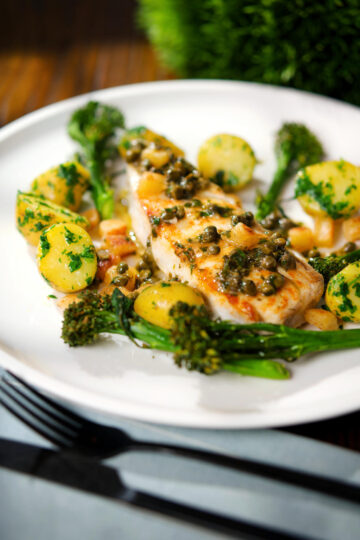
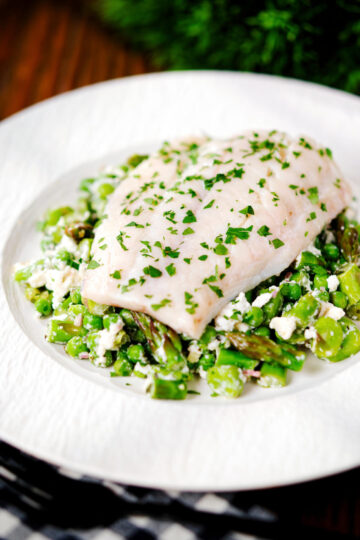
Whole roast "baby" turbot with capers, butter and vermouth served with new potatoes, samphire, asparagus, sugar snap peas and garden peas.
This delicious meal may look and sound both difficult and expensive, but baby turbot is a fraction of the price of mature fish and tastes fantastic. It's also easy to cook and will go from your fridge to your table in around 40 minutes.
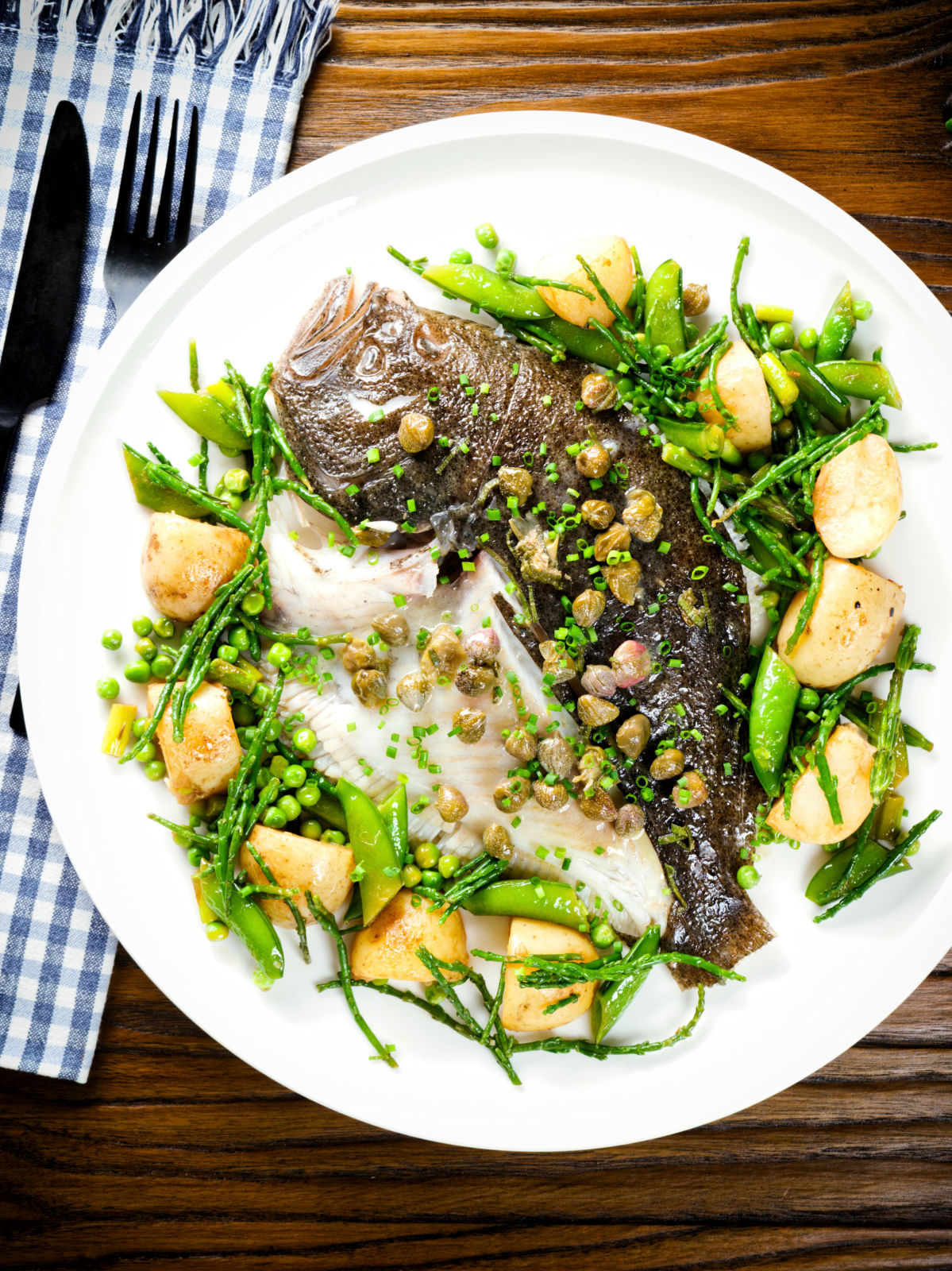
Whole Baked "Baby" Turbot
If you were to ask me my favourite "way" to cook, this is it right here, a series of beautiful ingredients, cooked perfectly with minimal fuss!
You will see it time and time again on my site in dishes like my pan-fried skate wings, baked hake fillet with romesco sauce, roasted halibut with potted shrimp sauce and pan-fried cod with chorizo and potatoes, and I make no apologies for it!
Here we have roast "baby" turbot with vermouth and capers, served as a whole meal with new potatoes and spring/summer vegetables.
Turbot is often seen as one of the finest fish that you can put on your plate, with bog old fish fetching between £40 and £80 per kilo.
Don't worry, this meal costs significantly less than that. I picked up these two day-boat baby turbot for £10, which worked out to be about £12.50 a kilo. Expensive, kinda, but am I worth it, definitely!
With fish this good, you need to do very little.
I make a quick butter, caper and vermouth sauce to roast them in, which perfectly contrasts and complements the sweet, mild white flesh of the fish. And that roasting takes just 10-12 minutes.
If you boil the potatoes whilst you are preparing your fish, then the glorious potato side dish cooks whilst the fish is roasting.
And this very special, kinda blingy meal is done and dusted in around 40 minutes!

Frequently Asked Questions
Can I use a different type of fish?
Yes, so long as the fish is big enough, around 350-400g each, and it is a "flat fish.
Baby Brill would be the best, but plaice, sole or flounder should work fine, but check the internal temperature after 10 minutes.
Can I eat the skin?
No, the skin on flat fish is generally not nice to eat, particularly the dark skin on the top of the fish.
Steps 2, 3 and 4 in my recipe make it easier to remove that skin once the fish is cooked. You can either remove it for the person you are cooking for or remove it before serving.
Do I have to use vermouth?
No, dry white wine and dry sherry work equally well; they will change the flavour subtly, but it will still be delicious.
If you are avoiding alcohol, add a splash of lemon juice, white wine or sherry vinegar and skip the reduction phase.
Can I make this in advance?
No, this recipe is all about precise cooking, and cooling and reheating will ruin the fish.

Serving Suggestions
The roasted turbot recipe is presented as a complete meal. However, if you want to change up the sides, here are a few alternative options that work just as well.
On a hot summer's day, a warm or room-temperature side dish works beautifully with this recipe.
Sticking with similar flavours to my original recipe, my samphire salad recipe would be the perfect choice. If you find samphire hard to find, how about the lovely asparagus, radish and new potato salad?
As a Brit, fish with potatoes is a thing, now I wouldn't serve this with chips, but some roasted, crushed new potatoes would be awesome. As would some Parmentier potatoes.
If I were to do either of the previous two options, I would probably roast some tenderstem broccoli in the pan with the fish. It will cook perfectly in the same amount of time.

Equipment Used
I only name-check brands of equipment if I think that they make a material difference to a recipe. But if you have any questions, feel free to ask them in the comments section below the recipe.
- Oven.
- Baking tray, use one large enough to hold both fish in a single layer.
- Hob/Stovetop.
- 20cm or 8" saucepan.
- 30cm or 12" frying pan (with a lid).
- 15cm or 6" saucepan.
- Sieve or colander.
- Stirring, serving spoons and spatulas.
- Whisk.
- Chopping board.
- Kitchen knife.
- Scissors.
- A combination of weighing scales, a measuring jug, measuring cups and spoons.
- Quick-read meat thermometer (optional).

Roasted Turbot Recipe with New Potatoes, Summer Greens and Capers
Ingredients
For the Turbot:
- 2 Whole Baby Turbot Around 750g Total
- 50 ml Dry Vermouth 3 tablespoon + 1 Tsp
- 35 g Butter 2 Tbsp
- 50 g Capers ¼ Cup
- 6-8 Sage Leaves
- ¼ teaspoon Salt
For the Potatoes and Veggies:
- 350 g New Potatoes 2 Cups
- 100 g Sugar Snap Peas 1 Cup
- 5-6 Thin Asparagus Spears
- 75 g Peas ¾ Cup
- 100 g Samphire 1 Cup
- 35 g Butter 2 Tbsp
- 35 ml Dry Vermouth 2 tablespoon + 1 Tsp
- 1 Pinch Coarse Sea Salt Plus, extra to boil the potatoes.
Instructions
- Begin by bringing a 20cm (8") saucepan of well-salted water to a boil. I use 1½ teaspoons in a pan this size.
- Whilst the water is coming to a boil, begin to prepare the turbot (keeping an eye on the water, see next step).Cut the fins from the side of the turbot, and you can remove the head if you wish. I never do this.

- Feel down the centre of the fish, from the head to the tail. You will find a bone; using a sharp knife, cut along both sides of this bone. Then flip the fish over and repeat this process.
- Then, along the side of the fish, make a shallow incision along the side of the fillet.
- Once the water comes to a boil, cut the new potatoes into bite-sized pieces and cook them in the boiling water for 12-15 minutes or until very nearly cooked. Return to preparing the fish whilst this happens.Then drain the potatoes and set them aside.
- If you are using frozen peas, defrost them by running cold water over them.
- Cut the sugar snap peas in half (at a 45° angle) and trim them of any woody bits.
- Cut the spears from the asparagus and chop the stalks into 1cm (just under ½") lengths, discarding any woody parts.
- Shred the sage leaves as finely as you can.
- Heat a 15cm (6") saucepan over a high heat and add the vermouth, reduce this by half, then reduce the heat to medium.
- Throw in the butter, sage, capers and salt into the vermouth and whisk until combined.
- Place the prepared fish into a large baking tray and pour over the caper, vermouth and butter mix.Bake in a preheated oven (180°C or 350°F) and cook for 10-12 minutes. You are looking for an internal temperature of around 52-53°C or 125-127°F.
- Heat a 30cm (12") frying pan over a medium-high heat, and when it is hot, add the butter for the vegetable mix.
- When the butter begins to foam, add the potatoes and cook for 4-5 minutes, tossing until they start to become a little golden.
- Add the sugar snap peas and chopped asparagus and cook for another minute.
- Toss in the peas and samphire, season with a generous pinch of sea salt.
- Pour in the vermouth for the vegetable mix, toss to combine, add a lid and remove the pan from the heat. Set aside until the fish is cooked, which should be another minute or two, then serve.