
Traditional Cornish Pasty a British Food Icon

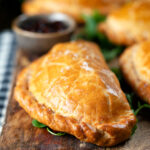
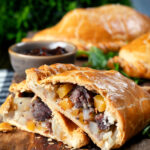

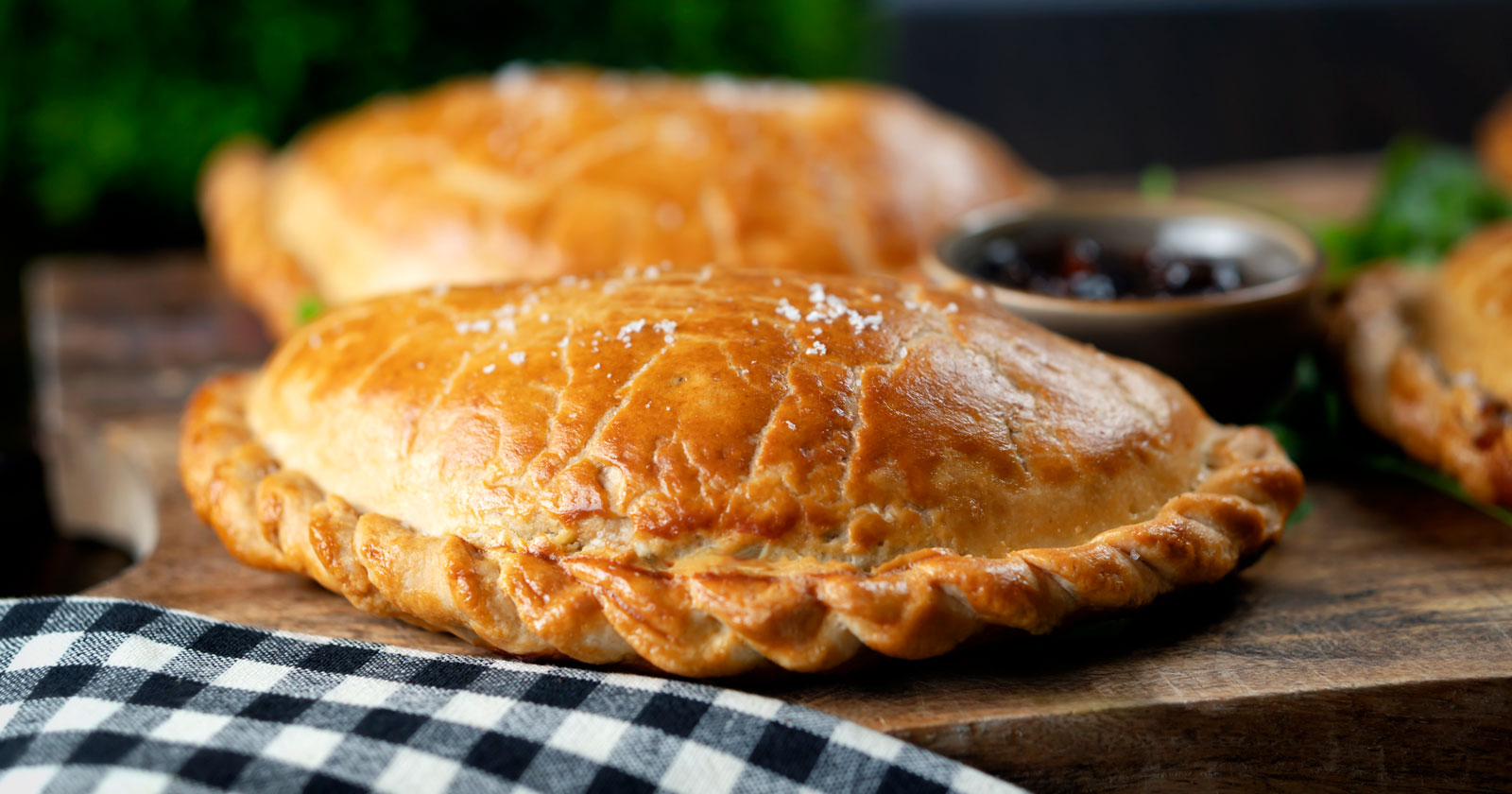
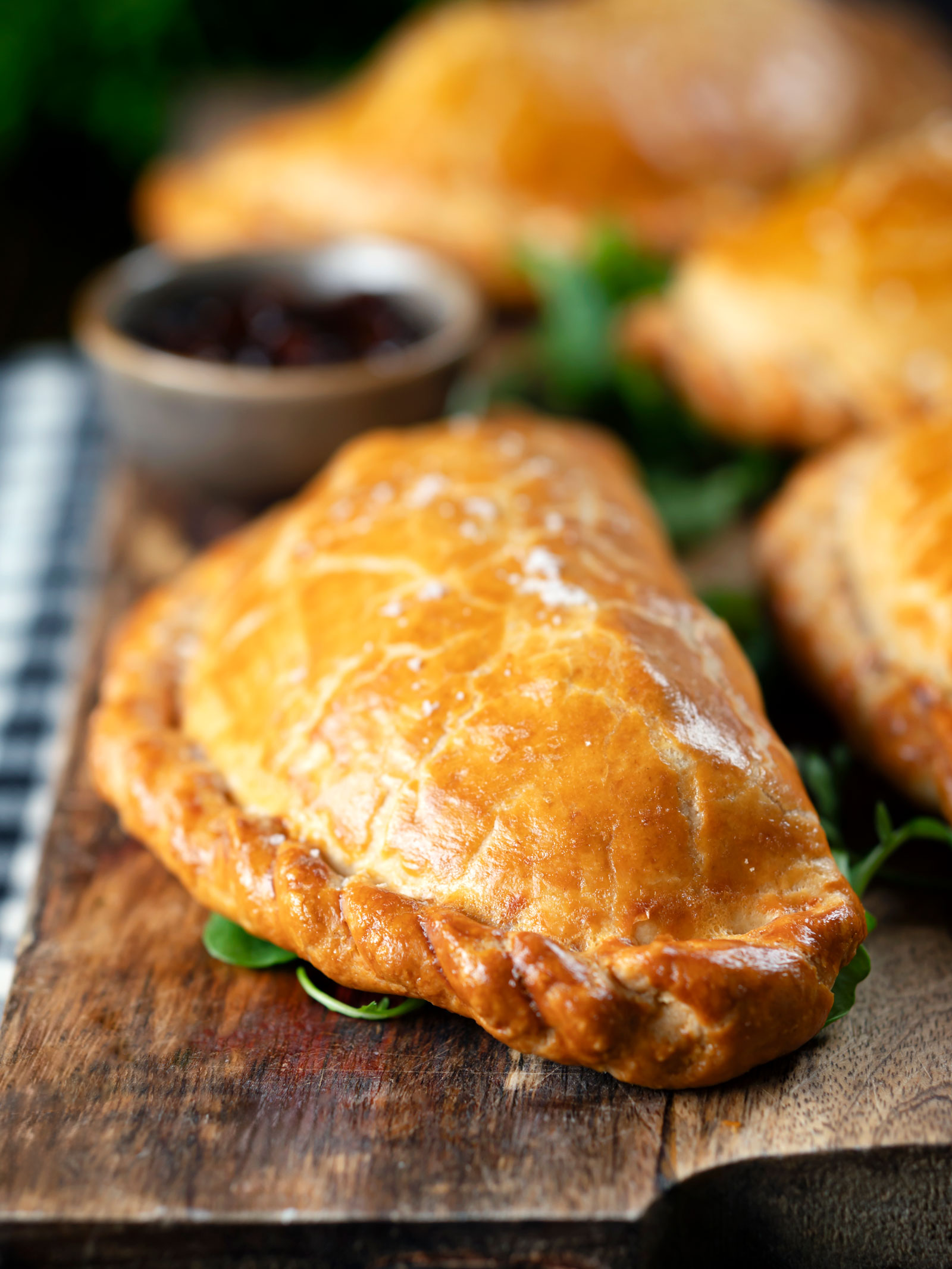
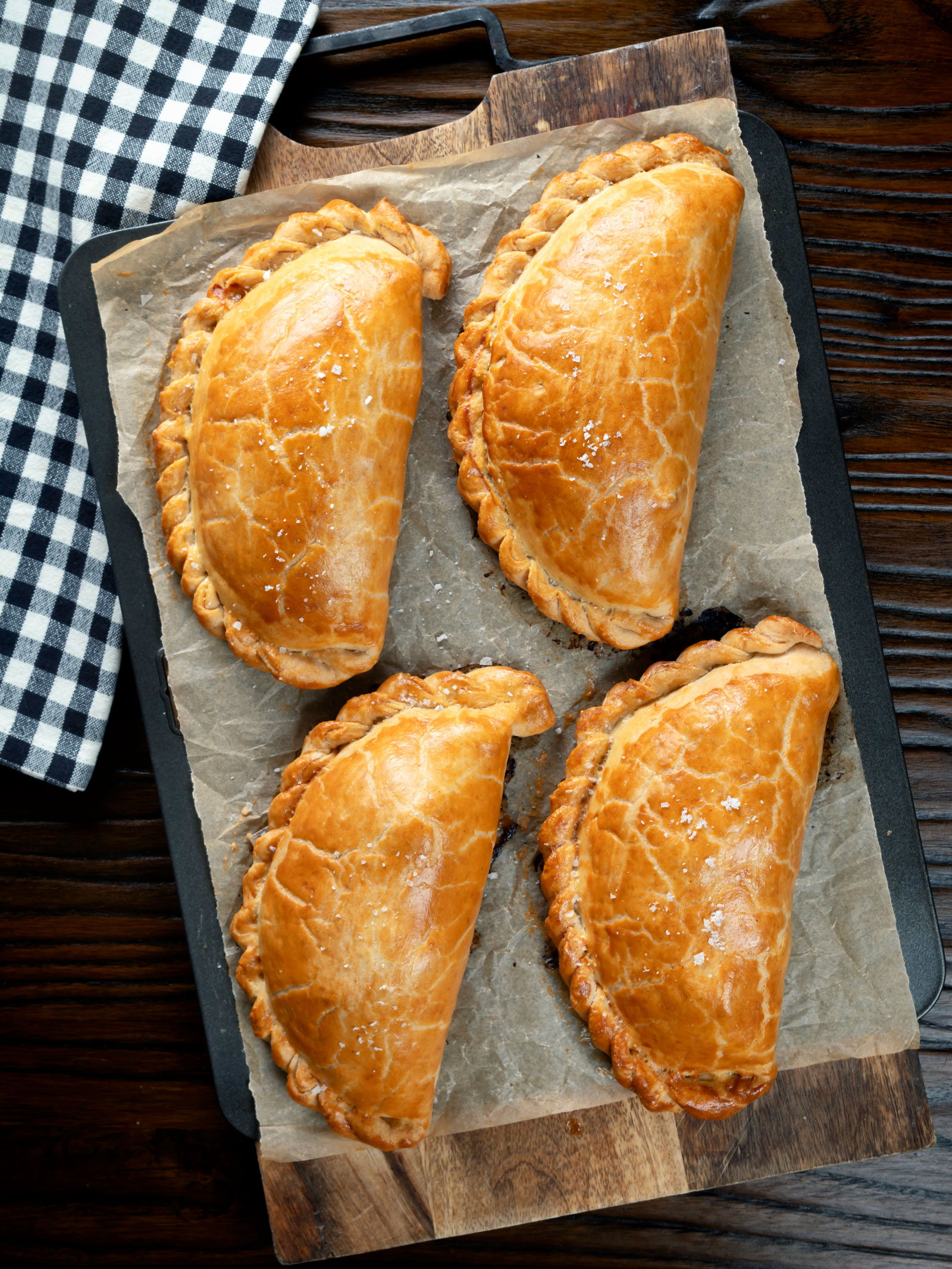
The traditional Cornish Pasty dates back to the 13th century and is a pie that squeezes a great deal from pastry, beef, swede and potatoes!
Whether you serve them for dinner or stick them in your lunchbox, these treats are the ultimate British pie!
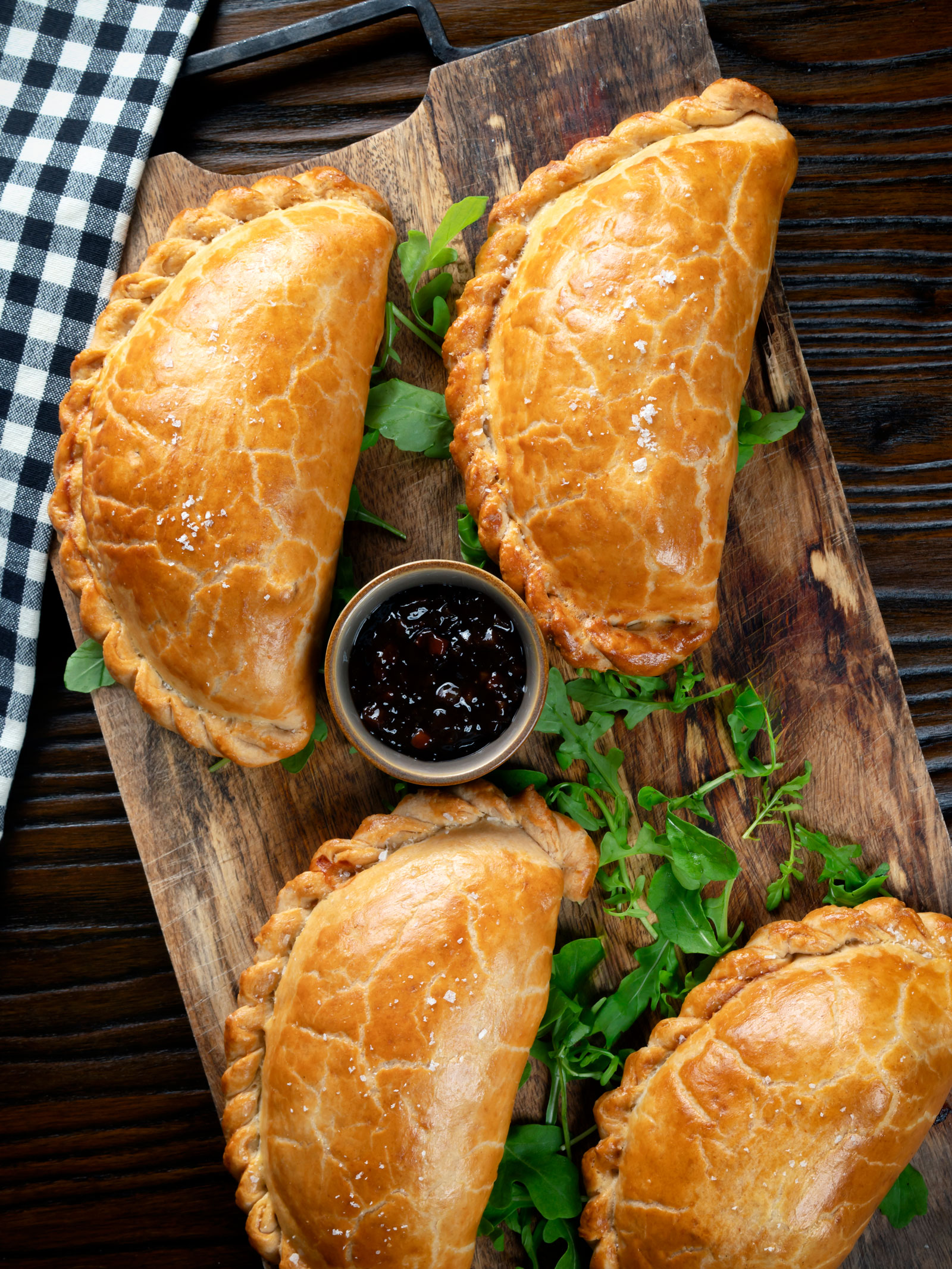
Homemade Cornish Pasties
Cornish Pasties date back to the 13th century and unsurprisingly are the source of much discussion, when I say discussion, I mean argument!
However, to call this dish famous in the UK would be an understatement.
Any foodstuff name-checked in classics like the Robin Hood Chronicles, the Canterbury Tales and no less than three works of Shakespeare is no shrinking violet.
In short, the humble Cornish pasty is nothing more than a ‘hand pie’ as I see them called on the web in some nations. The filling is with four very good things and some salt and pepper.
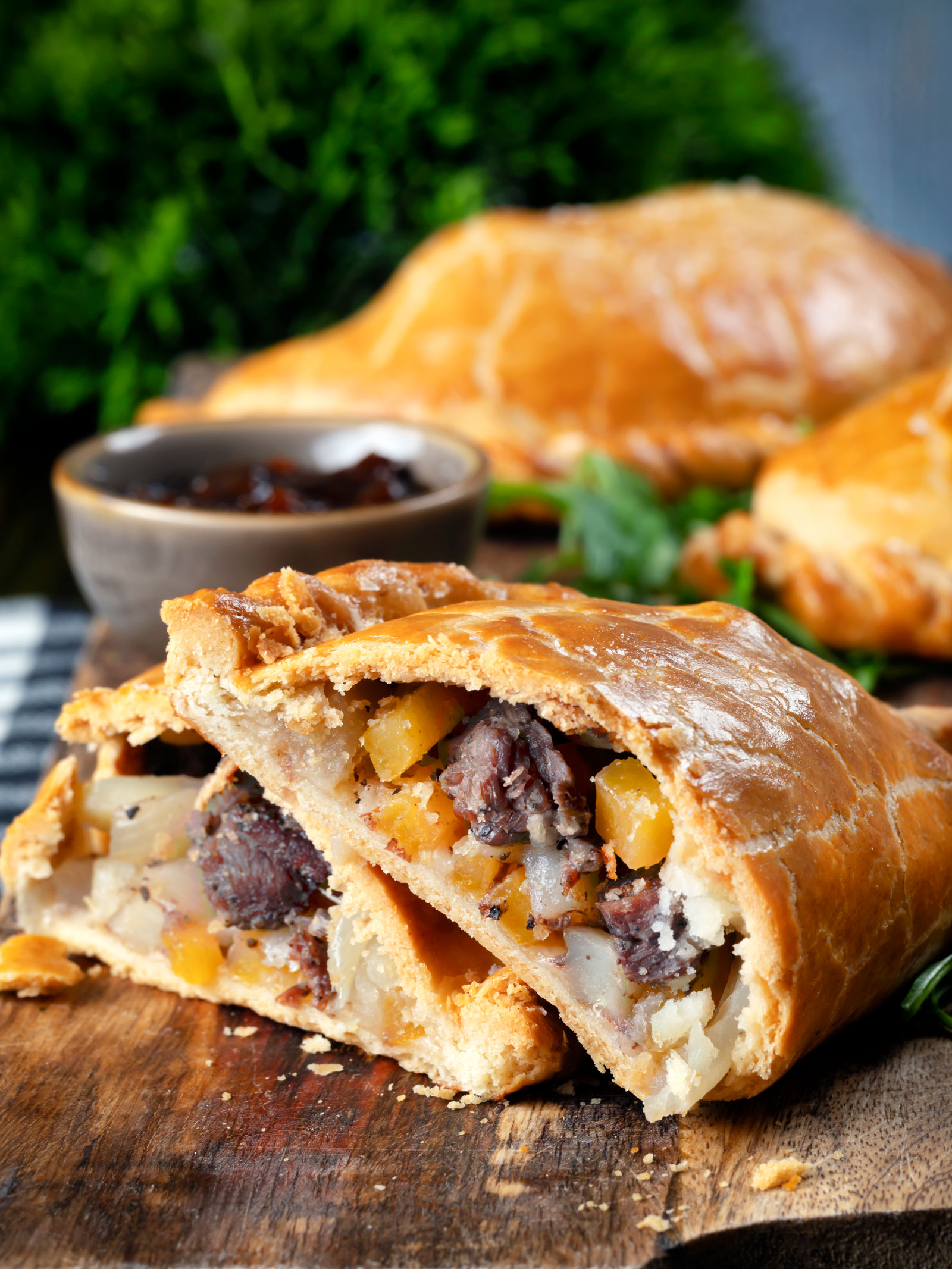
Those four things are Potato, Onion, Swede (rutabaga elsewhere) and finally beef. It is then seasoned and wrapped in a pastry.
Traditionally, the food of Cornish ‘miners’, if rumour is to be believed. The crimped crust serves as a handhold and was discarded, because, well, mucky hands of course.
I’ll leave you with one final bit of pasty trivia. A pasty crimped by a
Frequently Asked Questions
What pastry should I use?
Without reservation, I recommend making your own pastry for a Cornish pasty.
Shortcrust pastry is used for a traditional Cornish Pasty. Mixing half butter and half beef dripping is the perfect mix as far as I am concerned. It is simple, and all you have to do is work cold and use a food processor.
Can I use store-bought pastry?
You can. Store-bought shortcrust pastry is pretty good, but the sizes of packets are not ideal. However, you can freeze the leftover pastry and use it at a later date.
What cut of beef should I use?
Traditionally, skirt or flank is used as the filling for Cornish pasties; however, I have used both rump and sirloin in the past, and it works just fine.
Some recipes suggest using turnip and not swede. What is traditional?
This is often confusing for the simple fact that a swede is a turnip, but not all turnips are swedes.
Traditionally, the yellow-fleshed turnip, aka swede or rutabaga, is used; however, in Cornwall (and other places in the UK), a swede is just called a turnip.
Does the type of potato make a difference?
Yes, the potatoes for a Cornish pasty should be waxy so that they hold their form and texture. However, I must confess that I do have a weakness for occasionally using a floury potato like King Edwards or Maris Piper.
How to Crimp a Pasty
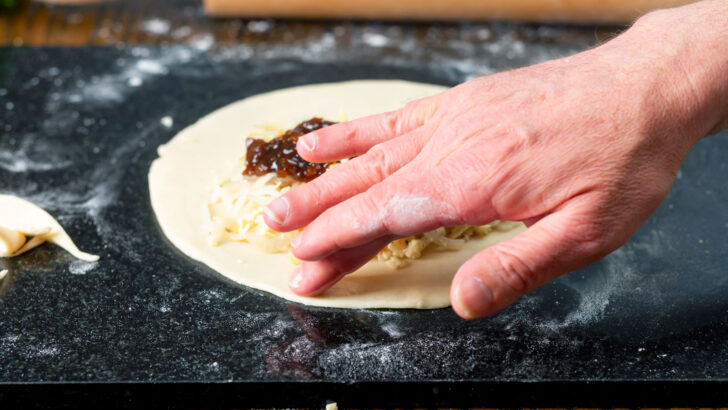
Crimping pasties may seem tricky, but with a bit of practice, it is quite easy. Here is a visual guide on how I do it. The images are from my Cheese and Onion Pasty recipe, but the process is identical:
1: Fill the centre of the pastry with your filling, leaving around 25mm (1″) at the edges, then brush the edge with water. Using your finger is the easiest way to do this.
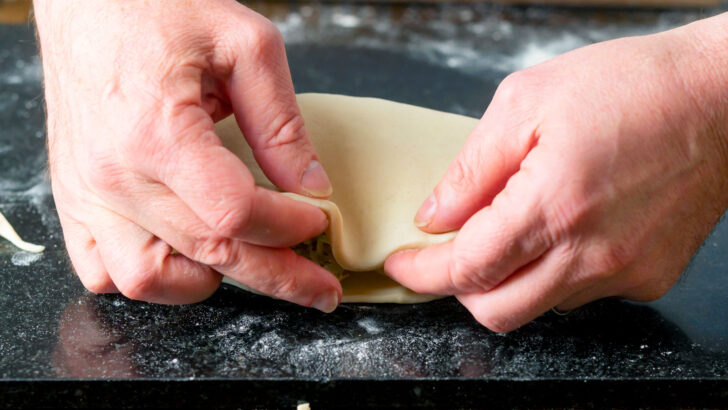
2: Fold over the pastry to form a half-moon shape.
3: Press the edges to form a seal.
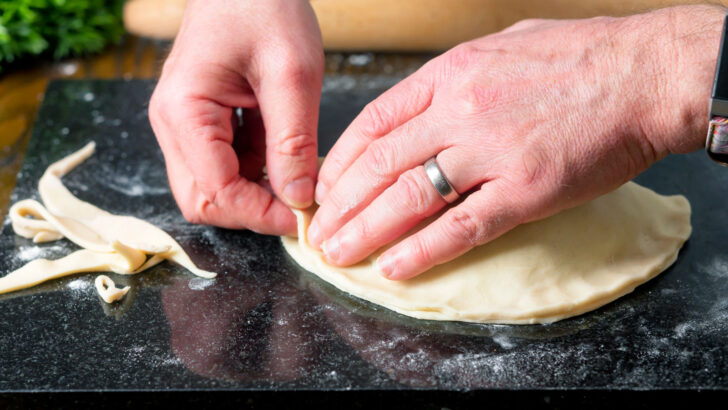
4: Pick up the pasty in your “dominant” hand with one end of the half-moon shape pointed at you. Take the corner of the pastry between your thumb and forefinger with your thumb at the top, and fold the pastry over at a 45° angle.
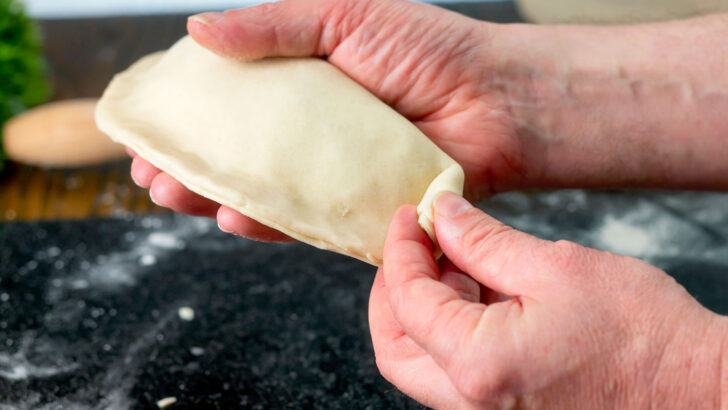
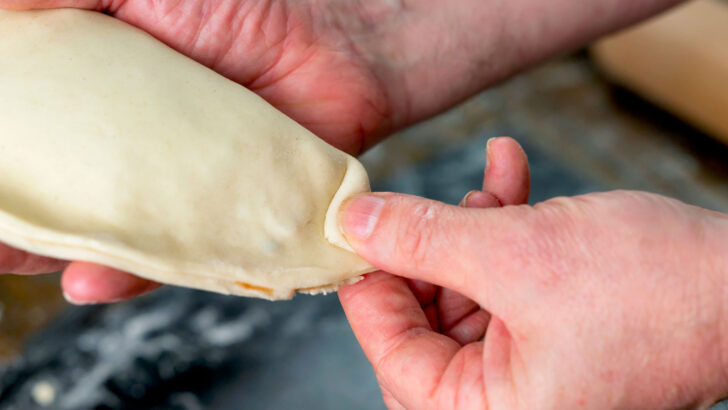
5: Move along the pastry and repeat the process. But this time, squeeze to seal and pull back the finger at the bottom of the pastry to form a lobe, then fold over to create the crimp.
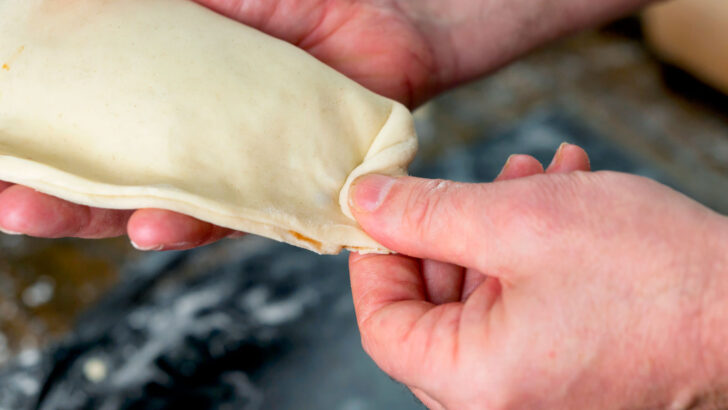
6: Repeat this process, working around the pastry, turning as you go so that your hand stays in the same position.
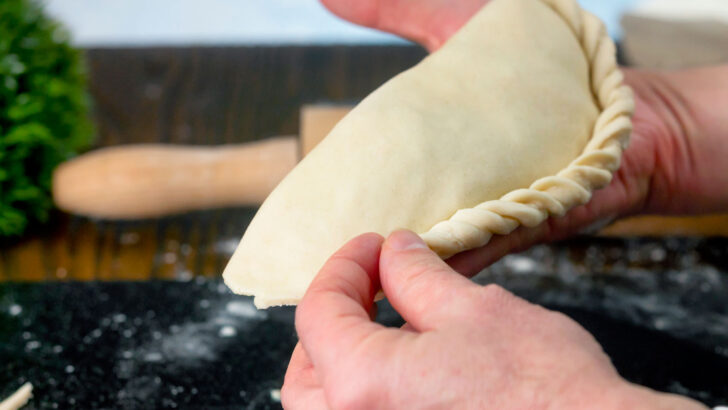
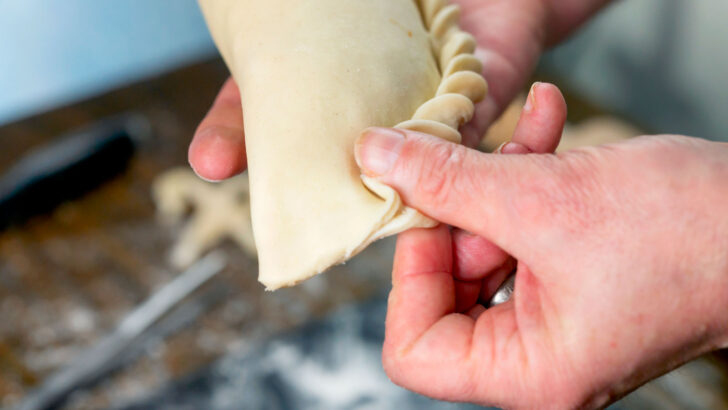
7: When you get to the end, fold the final crimp under the pasty.
Serving Suggestions
I'd usually munch on a Cornish pasty for lunch and maybe add a big dollop of piccalilli or some other type of chutney or pickle.
However, as a kid, I would have them with chips... yes, more potatoes and baked beans, and I love it.
They are also fantastic as part of a picnic, throw in a couple of scotch eggs, a couple of corned beef pasties or some cheese and bacon turnovers and some salad, and you are laughing.
Equipment Used
I only name-check brands of equipment if I think that they make a material difference to a recipe. But if you have any questions, feel free to ask them in the comments section below the recipe.
- Oven.
- Baking tray.
- Mixing bowl.
- Chopping board.
- Kicthen knife.
- Vegetable peeler.
- A combination of weighing scales, measuring cups and spoons.
- Food processor to make the pastry, you can do this by hand if you wish.
- Cling film.

Traditional Cornish Pasty Recipe
Ingredients
For the Pastry
- 400 g Plain Flour 3 Cups
- 100 g Butter ⅓ Cup
- 100 g Beef Dripping ⅓ Cup
- 6-7 tablespoon Water
- 1 Pinch Salt
- 1 Egg (for glazing the pastry)
For the Filling:
- 250 g Beef Skirt or Flank 9oz
- 1 Small Onion 75g
- 1 Small Waxy Potato 125g
- 125 g Swede 1 Cup
- 1½ teaspoon Coarse Sea Salt
- ¾-1 teaspoon Coarsely Ground Black Pepper
Instructions
- Weigh the flour into the bowl of a food processor and place it in the fridge.
- Grate the beef dripping and butter, and place them in a bowl in the freezer for 10 minutes.
- Add the vegetable fat and butter to the flour, add the pinch of salt and then pulse to create a breadcrumb-like texture.
- Add the water little by little until a ball forms in the food processor.
- Move the pastry to a work surface and form 4 hockey puck-shaped rounds (this will make it easier to roll them later), then wrap in cling film and let the pastry sit for 30 minutes to 1 hour. You can leave it for longer if you wish.
- Cut the beef into 2cm (¾) long strips around 5-6mm (¼") in profile and place into a mixing bowl.
- Top and tail the onion, then cut it in half and peel it. Cut the onion halves into 5-6mm (¼") thick strips from top to bottom and add them to the beef.
- Peel the potatoes and then cut the potato into "chips" around 20mmx3-4mmx10mm (¾"x⅛"½") and add them to the pasty filling.
- Peel and cut the swede into "chips" the same size as the potato, and throw it in with the rest of the ingredients.
- Add the salt and pepper, give everything a good mix and set aside.
- Roll out the pastry so that it is 3-4mm (around ⅛") thick and cut each into 4 x 225mm (9") circles.
- Add a quarter of the pasty filling to one half of the pastry disc, forming a "rugby ball" shape, leaving around 2.5cm or 1" of pastry at the edge.
- Brush the edge facing you with a little water, fold over the pastry, and push down to seal the edges. Then crimp by pinching between your thumb and forefinger, pull and twist, then move on to the next crimp.
- Beat the egg and then brush this over the pasties, then give them a sprinkle with coarse sea salt (this is not traditional, but I love it).
- Bake in the oven at 200°C or 390°F for 45 minutes.
I am a Brazilian trying to make a British dish in the USA! I was wondering what type of potatoes is the best to use. But anyways, love the recipe, thank you tons!
Hey Cecilia, sorry it took a while to respond, I was away over the holidays. You want a floury (mealy) potato for this recipe something like a russet would be ideal.
Enjoy
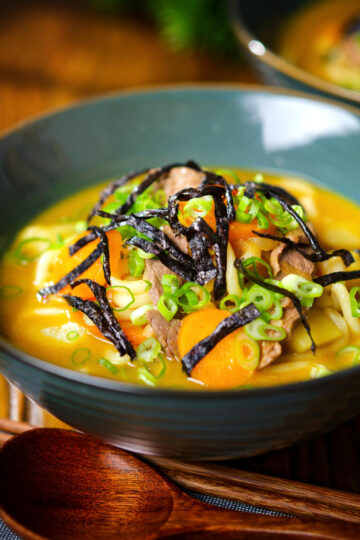
I see carrots in the picture but not in the ingredients list.🧐
You are seeing swede and the lighting is giving it a bit of an extra pop of orange, but it's definitely swede. I remember that I had to grow it because I could not buy it in Hungary (where I lived at the time).
I very much enjoyed making and eating these, though I must confess I made them with a turnip and venison as I had neither beef nor rutabaga.
I assume these pasties freeze well, but I would appreciate knowing whether to thaw them before reheating, or put them into the oven frozen.
I made the slow cooked rabbit legs with Indian flavors last week which was also a lovely meal. The success of both recipes makes me plan to prepare a different recipe from the website each week.
Hi Gina... Sorry it took a while to respond, I have been in the process of relocating.
I'm so glad that you found my site and that you are having such success, I'm loving the idea of a venison pasty so much that I will forgive the turnip lol 😀
Yes, you can freeze a pasty although they are much better frozen uncooked, I cook from frozen in a moderate (170°C-180°C or around 340-350°F) oven until piping hot in the middle and nicely coloured up. You can defrost for slightly better results, but do not defrost all of the way, I find cooking them when they are slightly firmer gives more pleasing results.
I was born in Cornwall over 70 years ago and it was the first thing you learned to cook . we used Skirt beef, potatoes, onions and swede salt, pepper and a few drops of water for the gravy. And the twist was always down the middle with your initial and hoped yours did not burst and loose it’s gravy.
No splitting here, it took years to get my crimping technique right but now it is as tight as a tight thing 🙂
My mother was born and raised in Cornwall. She came to Canada as a war bride and brought with her a great talent for making Cornish pasties. My favourite was potato, onion and egg. The egg was beaten with a fork and poured over the potato and onion. Salt and pepper added. I now believe this version happened when she was short of grocery money. For my sister and I, it's such a wonderful memory and not one of being short of anything. I just may bake today!
That sounds superb, I'd be completely down with that as a munch, add some baked beans on the side and I'd be in nostalgia heaven! One of my favourites is cheese and onion with lots of mustard 😀
Where does the trans fat come from in this recipe?
I have no idea I am afraid I use a third-party application to provide nutritional data and it is to be used as a guide only.
@E.N.L, most likely from the lard and sirloin steak.
When I was 10,11 and 12 I lived in Adelaide,Australia. On the playground there was a covered stand that was open around noon and they sold cornish pastry pies.Wonderful memories. They had a certain spice that I couldn't discern,and they wouldn't tell me what it was.I think someone else must have made them and this person just sold them.What memories !!!!!
Traditionally the only spice used is black pepper and there was always loads of it. But I have had them with all sorts in and almost always love them. Food memories are always so powerful and make me smile!
Here in the upper peninsula of Michigan USA, the Finns have stolen the pasty and call it a Finnish Pasty! I always correct them and get into wild arguments about this. They even add carrots! Lends the wrong flavor. I am Finnish by heritage, but one of my grandfathers was born in St. Erth, Cornwall and your recipe is similar to mine. Made 19 the other day and were just delicious. I used ground beef and pork, but usually do steak like you do in this recipe.
lol, ain't nothing like a good food argument! This is super traditional and sticks to the "accepted" definition of a Cornish pasty, but I love to play, I do one with chicken thighs and curry flavours that is superb, I doubt I'd call it a Cornish pasty though 😉
I understand that left handed people were called cock-handed, like cock-eyed, and it was frowned upon to be cock-handed. Everyone was forced to use their right hand or be ridiculed. Maybe that is were part of the left / right description came from?
Entirely possible although I have never heard the phrase cock handed it was "cack" handed where I grew up in the Midlands...
On the nose. Only reservation is the butter, personally I go for 100% lard for the pastry. Also agree with previous review (P.L.) that hand-making the shortcrust gives it the irregularity in texture that makes the pasty itself special - I very much doubt that cornish miners' wives would have been aware of, let alone owned, a food processor. Otherwise, thank you for making people aware that a proper Cornish pasty is not some awful mush of dogfood wrapped in soggy puff pastry. Respect.
Hand made pastry may work in moderate climates but in my hot kitchen then it is an impossibility for a huge part of the year, this is likely the case for my global audience too 😉 Making it in a food processor gives a consistent pastry all year round, I'll likely update my post to make this clear over the next few days 🙂 I have genuinely never understood the puff pastry thing for pasties and heaven forbid sausage rolls, sacrilege I say!
A cornish pasty is a beautiful thing, hard to believe how much flavour you can get out of so few ingredients really.
Food Processor? You have got to be kidding me! My grandmother and mother did not know these machines existed. This is supposed to show people how pasties were originally made. Use what God gave you. Your hands.
The household food mixer predates the domestic refrigerator, both are 500 years younger than the Pasty... Should we also not chill the butter for the pastry, or indeed refrigerate the beef #askingforafriend
Great memories of Padstow, I need to try this ASAP
These pasties are looking to die for! I would have 3 and ask for seconds too! Great photography too x
These look absolutely mouth watering...and that filling sounds delicious!! What a perfect springtime dish! Can't wait to make some!
Wow, these are Cornish Pasty really impressive! Looks very tasty! I definitely want to try this cool recipe! I think this will be one of my favorites. Thank you for sharing this great recipe!
Can you believe that I have never had a real Cornish pasty before! I need to try and make these at the weekend.
Bravo! I grew up in northern Michigan, where Cornish miners transplanted this tradition, and there, they're called pasties. I love them. I'm looking forward to trying your recipe.
Cheers Jeff... Enjoy, I can't really claim this one, this recipe has largely remained unchanged for hundreds of years and is largely identical to the 'protected' status recipe, just slightly different vegetable ratios 🙂
Great memories of Padstow, I need to try this ASAP
Have fun, they are so insanely simple in terms of there filling but the flavour from them is insane.
These pasties are looking to die for! I would have 3 and ask for seconds too! Great photography too x
Thanks Tania, the second was tough to turn down... So I didn't 😉
I have never made anything this elegant what a great job you did they look flaky and perfect
Thank you, although I'm not sure anyone has ever called the humble Cornish Pasty elegant before 😀
These look absolutely mouth watering...and that filling sounds delicious!! What a perfect springtime dish! Can't wait to make some!
They make a fab picnic dish, they are robust enough to be rattled around a little and add some chutney and you are laughing 🙂
Wow, these are Cornish Pasty really impressive! Looks very tasty! I definitely want to try this cool recipe! I think this will be one of my favorites. Thank you for sharing this great recipe!
Thanks Veema
Can you believe that I have never had a real Cornish pasty before! I need to try and make these at the weekend.
lol, even in Cornwall they argue about a 'real Cornish' pasty 😉 Enjoy and chuck what ever you want in there and make it your own, just don't tell anyone form Cornwall 😉
@Brian Jones, Just made these today, with the last of our only bag of plain flour (there's none about in the shops). Flour well spent, thanks. I'm definately no chef; Whenever I cook, my family hate it, but tonight, they were quiet, and cleared their plates. So I'm calling that a success. The only reason I tried Cornish Pasties is because I had a big lump of swede left from a Jamie Oliver vegetarian cottage pie recipe, so couldn't resist. The big worry was the pastry. My Mum could never do shortcrust pastry.....always came out hard like ceramic, and I had inherited her 'problem'. Warm hands she always said, so I had to do as per instructions and use the food processor. It hasn't been used for 5-10 years so didn't work when i plugged it in. Fuse OK, and continuity OK from the plug to the inside connector block, and drive system not seized. Hmm...Turned out to be the brass pins on the plug had oxidized due to no use, and wouldn't pass current. Sorted that with a bit of wet & dry abrasive and back on my way again. The fats & flour and salt mixed up nice & crumbly, and instruction 2 suggests water in all at once...or it would have said gradually right? So I poured it in and oh dear...there goes the crumblyness...well on the way to being 'ceramic'. It didn't form a ball until the pastry mix was pretty well creamed, so I wasn't expecting a good result. I couldn't wait 3 hours for chilling, because I'd already lost 3/4hr messing about with the mixer, and I was getting moaned at for it all taking too long. I assumed there's no point waiting 3hrs if I've already spoilt it so it only got 2hrs. Should have used the freezer! And rolling it out thin enough to span 8" diameter discs surely knocked any remaining crumble out of it. It looked like solid sheets of clay. But despite everything looking like becoming another bin job, once out of the oven, the 4 pasties were just like the picture. Maybe lost a bit of moisture from the filling due to a pastry puncture here & there but these were good. I wish I'd put more pepper in though. Using a pepper grinder doesn't give fine powder, so I suspect a half teaspoon of coarse is 50% air so I wish I'd doubled the volume to 1tsp. When we can get some flour, I'm doing these again. Cheers, Allan
Thanks for taking the time to write, and I hope you don't leave your food processor alone for as long in future 😀
I too struggle with pastry making, it is one of my least favourite jobs to do in the kitchen, particularly given that I live in a place where kitchens can get real hot real quick.
I like this approach it is quick and simple and I can not tell the difference between the stuff that I make by hand and the stuff that I make in the food processor.
Chuffed that your family liked these, I love making them, although swede is a bugger to find here sadly!